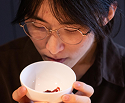
 01
Notice
Taste and smell ingredients, then describe sensory attributes, memories, and cultural references.
UIST ’26 workshop · Detroit · November 2 2026
A full-day participatory workshop exploring how computational interfaces can help communities document, share, and collaboratively create flavor experiences through boba tea.
The sign-up sheet helps us learn more about you before the workshop.
Workshop capacity is limited, so please register early.
Invited Talk

Culinary Education Designer (Principal Teaching Fellow), Department of Chemistry, Imperial College London
Computational gastronomy has long represented food through shared flavour compounds and recipe co-occurrence, from the original flavour network to FlavorGraph. In earlier work we showed that such embeddings already encode interpretable culinary dimensions, spanning taste, texture, geography, processing and culture. Epicure took this a step further: three sibling models trained on 4.1 million recipes in seven languages, each weighting chemistry and cooking practice differently. You can ask either “what do I cook this with?” or “what can substitute this?” (with mixed results), and steer from the familiar to the unexplored with a continuous dial. Rotate chocolate towards sweet baking, and the chemistry-driven model lands on a neighbourhood of red bean, matcha and purple sweet potato. I’ll talk about how we constructed these models, what we are aiming to do in future work, and how tools like this might sit alongside personal and cultural interpretation.
Dr Jakub Radzikowski is Culinary Education Designer (Principal Teaching Fellow) in Chemistry at Imperial College London. Since 2019 he has co-developed Chemical Kitchen, which teaches laboratory skills through professional cooking. The approach has grown into Medical and Biomedical Kitchen courses and a partnership with TUM, and its evaluations show the least confident students gain the most. He also co-developed the pandemic “Lab in a Box”, part of an RSC prize-winning project that is now held by the Science Museum Group. A molecular biologist (PhD, Groningen) and Le Cordon Bleu-trained chef who cooked in Michelin-starred restaurants, he developed the Epicure ingredient embeddings and supervises doctoral research in computational gastronomy for sustainable protein. He is a Senior Fellow of the Higher Education Academy.
01 — Motivation
Computational flavor systems often represent food through ingredients, chemical compounds, recipe corpora, or machine-generated recommendations, leaving limited space for people to document and iterate their subjective experiences.
Bobapedia makes space for the archived experiences. Using shared sticky notes, participants record sensory impressions, personal associations, and cultural interpretations before designing drinks together. Together, we aim to explore:
How might computational interfaces help communities articulate, share, and iteratively refine their personal interpretations of taste?
01Taste and smell ingredients, then describe sensory attributes, memories, and cultural references.
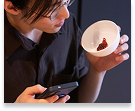 02
Record your impressions on sticky notes and compare how different people interpret the same flavor.
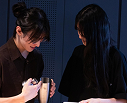 03
Design, prepare, and taste boba drinks inspired by ingredients, memories, and shared themes.
Workshop overview.
Short talks from the workshop organizers.
Flavour as a Map: Navigating the Geometry of Ingredients (talk + Q&A, remote via Zoom).
Coffee, set up ingredient table.
Share background, then “what boba means to me” on sticky notes.
Free tasting, one sticky note per ingredient impression.
Conference lunch, notes stay on wall.
Everyone shakes one basic milk tea.
Build a drink from the morning’s ingredient notes.
Write down how the drink came about.
Taste each other’s drinks.

National Taiwan University
Taipei, Taiwan
MIT CSAIL
Cambridge, MA, USA
University of Tokyo
Tokyo, Japan
MIT Media Lab / MIT EECS
Cambridge, MA, USA
MIT CSAIL
Cambridge, MA, USA
National Taiwan University
Taipei, Taiwan